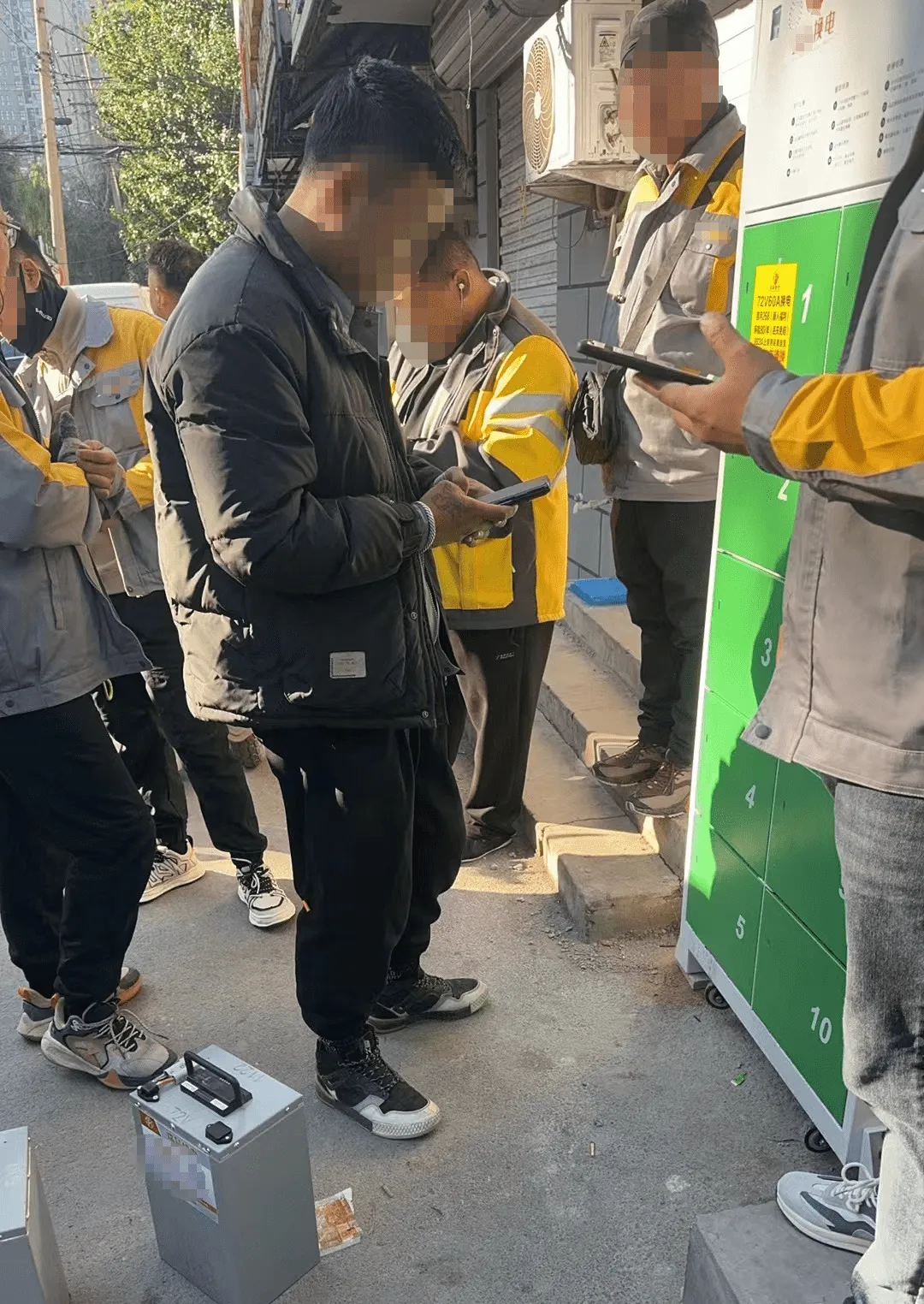
With the popularization of electric bicycles in courier, food delivery, and household scenarios, the site selection of battery swapping cabinets as infrastructure has become increasingly crucial. Based on national technical specifications and industry practices, this article systematically sorts out the site selection rules for battery swapping cabinets in three scenarios: food delivery, courier services, and household use.
Site Selection Rules for Food Delivery Battery Swapping Cabinets: Balancing Efficiency and Safety
Food delivery battery swapping cabinets must meet the high-frequency usage needs of riders while ensuring public safety, and their site selection shall follow the following principles:
Riders' Movement Routes as Priority
Core Area Coverage: Prioritize deployment in rider-dense areas such as commercial centers, office building clusters, and catering streets. For example, Nanjing requires that the straight-line distance between a battery swapping cabinet and rider gathering points (e.g., business districts, food delivery stations) be ≤ 500 meters.
Traffic Node Positioning: Must be located on couriers' unloading routes, such as within 50 meters of community gates, to avoid rider abandonment due to remote locations.
Strict Site Conditions
Basic Requirements: Installed on concrete floors with vertical inclination ≤ 5°; indoor installation density ≤ 10 compartments per square meter; no more than 5 cabinets in the same outdoor area with spacing ≥ 200mm.
Prohibited Areas: It is strictly forbidden to occupy fire escape routes or safe evacuation routes, and the fire separation distance from high-rise civil buildings shall be ≥ 9 meters.
Electrical and Fire Compliance
Grounding and Lightning Protection: The grounding resistance of the cabinet shell ≤ 4Ω, and the grounding area shall be clearly marked; fire alarm devices and automatic sprinkler systems must be equipped.
Temperature Control and Ventilation: When the indoor temperature reaches 35℃, the air exhaust volume shall be activated at 60m³/(h·㎡).
Operational Supporting Requirements
Data Supervision: Must connect to government supervision platforms (e.g., Nanjing's "Intelligent Charging and Swapping Network") to realize real-time upload of operational data.
User Services: Publicize operational information in a prominent position on the cabinet and establish a 24-hour fault response mechanism.

II. Site Selection Rules for Courier Battery Swapping Cabinets: Balancing Traffic and Costs
Courier battery swapping cabinets need to balance couriers' usage efficiency and site costs, with the following site selection strategies:
1. Traffic-Oriented Layout
- Community Type Screening: Prioritize young communities (with 25-40-year-olds accounting for over 60%), where daily courier volume is three times that of elderly communities; avoid new properties (occupancy rate <30%, daily parcels <50).
- Mixed Area Deployment: Residential-commercial mixed areas (office buildings + residences) are prime locations. Overlapping demand for package collection during white-collar workers' lunch breaks and delivery after work can increase daily access volume by 40%.
2. Cost Optimization Techniques
- Property Cooperation Model: Sign "betting agreements" with property management to reduce the base rent to 0.5 yuan per compartment per day, with commission per package for excess quantities.
- Utilizing Pre-Embedded Wires: Prioritize locations with pre-embedded wires, saving over 8,000 yuan in self-wiring costs.
3. Differentiated Operation Design
- Functional Customization: Fresh food communities require refrigerated compartments (idle rate <5%); maternal and child communities can access high-premium advertisements (e.g., advertising fees for milk powder/diapers are three times higher than ordinary ads).
- Movement Route Optimization: Cabinets must be located on couriers' unloading routes, such as within 50 meters of community gates, to avoid packages being abandoned at courier stations due to inconvenient operation.
III. Site Selection Rules for Household Battery Swapping Cabinets: Balancing Convenience and Compliance
Household battery swapping cabinets need to meet residents' daily usage needs while complying with community management norms, with the following key site selection points:
1. High-Pedestrian and Traffic Density Areas
- Area Selection: Prioritize deployment in electric vehicle-dense areas such as residential areas and industrial parks, ensuring users can reach them within a 5-minute walk.
- Traffic Nodes: Convenient transportation and parking nearby; avoid occupying fire escape routes or obstructing pedestrian traffic.
2. Compliance Requirements
- Legal Compliance: Abide by the "Electric Power Law" and "Civil Code"; consult the power supply department and complete relevant procedures before installation. Respect the rights and interests of other owners to avoid issues such as noise and road occupation.
- Safety Distance: Maintain a reasonable safety distance from crowded places such as government agencies, schools, and hospitals; do not install in low-lying or water-prone areas.
3. Environmental Coordination
- Visual Integration: The cabinet's appearance must coordinate with the community environment to avoid being obtrusive. In humid or extremely cold areas, it is advisable to install indoors or equip with rain and snow protection facilities.
- Space Reservation: Reserve space for equipment replacement and maintenance, and ensure the front access space is ≥1000mm.
IV. National Standards and Local Practices: Unified Norms with Differentiated Implementation
Currently, at the national level, the core standard is "Centralized Charging Facilities for Electric Bicycles - Part 1: Technical Specifications" (GB/T42236.1), which sets clear requirements for battery swapping cabinets in terms of electrical safety, fire protection design, and grounding resistance. At the local level, implementation is refined through legislation or regulatory documents:
- Nanjing: Clarified the principle of "battery swapping cabinets as the mainstay, charging piles as supplementary," requiring enterprises to obtain the consent of the site owner or manager and prohibiting occupation of fire escape routes.
- Shanghai: Formulated the "Work Plan for Promoting the Construction and Management of Electric Bicycle Charging and Swapping Cabinets," mandating that cabinets and batteries meet technical safety standards and establishing a waste battery recycling system.
- Chengdu: Promoted legislation through procuratorial suggestions, incorporating the safety supervision of battery swapping cabinets into the "Regulations of Chengdu on the Administration of Non-Motor Vehicles" and requiring enterprises to sign fire safety commitment letters.
- Site selection for food delivery, courier, and household battery swapping cabinets must align with scenario-specific characteristics and strike a balance between efficiency, cost, safety, and compliance. In the future, with the improvement of national standards and the deepening of local practices, site selection for battery swapping cabinets will become more refined and intelligent—for example, analyzing riders' movement routes through AI heat maps or optimizing property cooperation models via "betting agreements." Enterprises need to keep pace with policy directions and build a site selection system integrating "technical compliance + scenario adaptation" to support the sustainable development of the battery swapping industry.