
Battery swapping cabinets and charging cabinets represent two distinct modes of power replenishment. Simply put, battery swapping cabinets involve replacing the battery, whereas charging cabinets require placing the battery inside the cabinet to wait for charging. This article will introduce the differences between battery swapping and charging cabinets.
Battery Swapping Cabinet
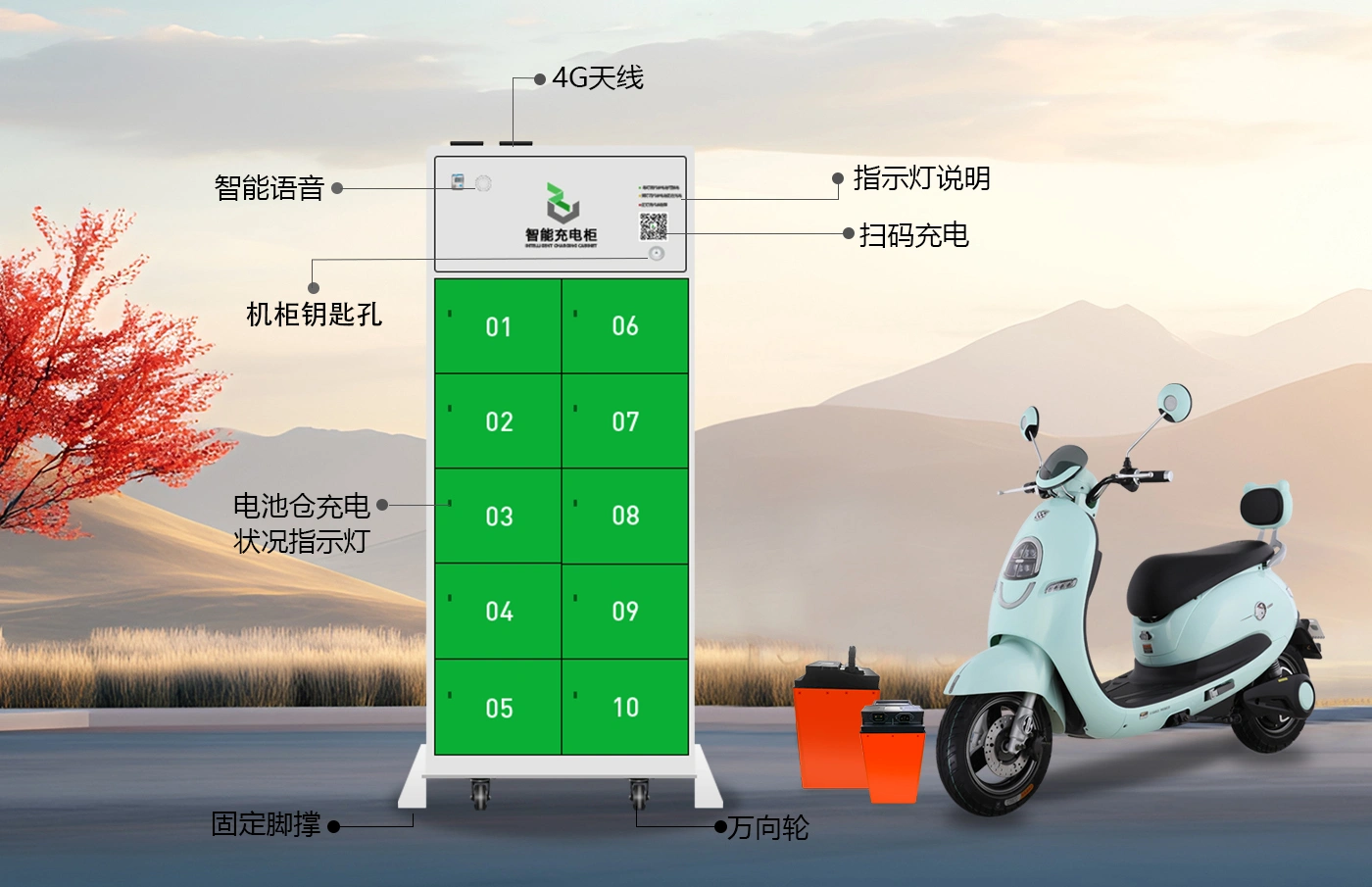
Its core function is “battery swapping.” Users take out the depleted battery and place it in a designated slot of the swapping cabinet, then retrieve a fully charged battery from the cabinet. The entire process is as quick and convenient as replacing dry batteries.
Battery swapping cabinets are typically connected to a battery operation management system, which can monitor real-time information such as the battery's charging status and health condition. For example, the ZhiXun battery swapping cabinet features sevenfold safety protection functions, ensuring that the battery swapped out is safe and sufficiently charged.
Charging Cabinet
The main function is “charging.” After users place the battery into the charging cabinet, the cabinet charges the battery according to a preset charging mode.
The interior of a charging cabinet includes charging circuits and protective circuits. The charging circuits provide appropriate charging current and voltage for the battery, while the protective circuits prevent issues such as overcharging, over-discharging, and short circuits. For example, when the battery reaches the set full charge level, the charging circuit automatically stops to avoid damaging the battery.
Application Scenarios of Battery Swapping Cabinets
Battery swapping cabinets are widely used in scenarios where operational efficiency is extremely critical, such as food delivery and courier services. Taking the food delivery industry as an example, delivery riders have highly valuable time. Battery swapping cabinets enable them to quickly replace batteries and resume work, significantly reducing the time spent waiting for batteries to charge, thereby improving delivery efficiency.
They are also applicable in the shared mobility sector, such as shared electric scooters. When a vehicle runs low on power, operators can quickly restore it to service through battery swapping, ensuring the continuity of shared services.
Application Scenarios of Charging Cabinets
Charging cabinets are more suitable for scenarios where battery charging is less time-sensitive. For instance, in residential communities, residents can place their e-bike batteries in charging cabinets for charging, typically overnight or when the vehicle is not in use, and retrieve the fully charged battery the next day.
For households, small teams, or innovative enterprises that have specific requirements for electric vehicle charging, charging cabinets with configurations like 3 or 9 compartments may be a better choice. They also provide a safe and centralized charging environment.

18926572469
18926572469

Add me on WeChat for consultation

Zhixun official account
Zhixun Battery Replacement Cabinet